

Title: Simulating the Hubbard model with moiré semiconductors
Speaker: Prof. Jie Shan
Time: 15:00, April 8(Wednesday)
Location: Room 215, No. 8 Hainayuan Building
Abstract:
The Hubbard model is a simple theoretical model of interacting quantum particles in a lattice. It is believed to capture the essential physics of many strongly correlated phenomena, such as high-temperature superconductivity, magnetism, and metal-insulator transitions, but has proved difficult to solve accurately except in one dimension. Physical realizations of the Hubbard model therefore have a vital role to play in the study of correlation physics. Moiré materials, formed by overlaying two van der Waals materials of slightly different orientations or lattice constants, have recently emerged as a promising Hubbard model simulator. In this talk, I will review the recent experimental progress on the realization of both the triangular and honeycomb lattice Hubbard models, and how the electronic phase diagram evolves with the U/W ratio (where U and W denote the onsite Coulomb repulsion and the moiré bandwidth, respectively).
Bio:
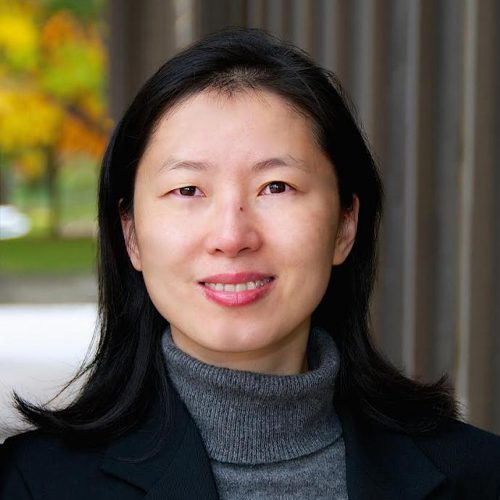
Jie Shan is a scientific member and director at the Max Planck Institute for the Structure and Dynamics of Matter (MPSD), Germany since 2025. She is also a professor of Applied and Engineering Physics and Physics at Cornell University, USA. Dr. Shan received her diploma in Mathematics and Physics from Moscow State University and Ph.D. in Physics from Columbia University. Before joining the MPSD, she taught at Case Western Reserve University, Pennsylvania State University and Cornell University. Research in her group is focused on experimental studies of the electronic and optical properties of nanoscale materials. Current activities involve the investigation of correlated and topological phenomena in novel two-dimensional crystals and heterostructures.