
Title: Unconventional superconductors and how to find them Superconductors
Speaker: Prof. F. Malte Grosche
Time: 15:30, 21 September (Monday)
Location: Room 215, No. 8 Hainayuan Building
Abstract:
One of the most exciting recent developments in condensed matter research has been the demonstration of superconductivity in superhydrides near room temperature but at very high pressure [1]. The compressed superhydrides demonstrate the potential of optimising a phonon-mediated superconducting pairing mechanism. Further gains are possible by widening the scope towards unconventional superconductors, which harness the strong electronic interactions that are also responsible for magnetism and that are known in some cases to reach coupling strengths equivalent to several thousand Kelvin.
We need new superconductors with superior properties, be it transition temperature, critical current or magnetic field, metallurgy or cost, because they can have transformative impact in applications such as powerful magnets in MRI scanners, particle accelerators and fusion research, lightweight generators, loss-free power transmission, microwave devices, low-power, fast electronics, and quantum computing.
Unconventional superconductivity is rare, and locating it by random search within the combinatorially large material space is ineffective. Fig. 1 illustrates that it is usually confined to a narrow parameter range close to the threshold of magnetic order [2, 3], which in turn can be used to guide the search. Using such heuristic guiding principles, the Quantum Matter group have found superconductivity in CePd2Si2, CeIn3, CeNi2Ge2, UGe2 and, recently, the layered iron germanide YFe2Ge2, its sister compound LuFe2Ge2, and the high pressure phase of CeSb2.
Complexity in quantum materials. Numerous factors – competing interactions, disorder, structural transitions, the role of orbital and charge degrees of freedom – interfere with simple guiding principles but also represent tuning parameters that may be used to advantage. Computer modelling can accelerate the search for unconventional superconductors and guide it towards technologically useful materials.
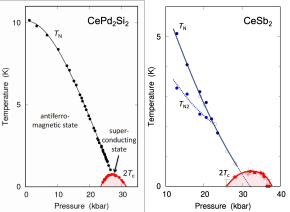
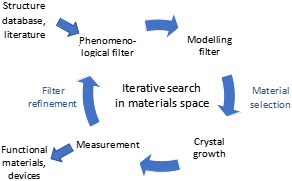
FIG. 1. (left) Guiding principle: typical phase diagrams of unconventional superconductors, showing a superconducting dome attached to the threshold of antiferromagnetic order [2, 3]. (right) Prospecting in material space: integrating model calculations, crystal growth and experimental investigation speeds up the search for functional superconductors.
Bio:
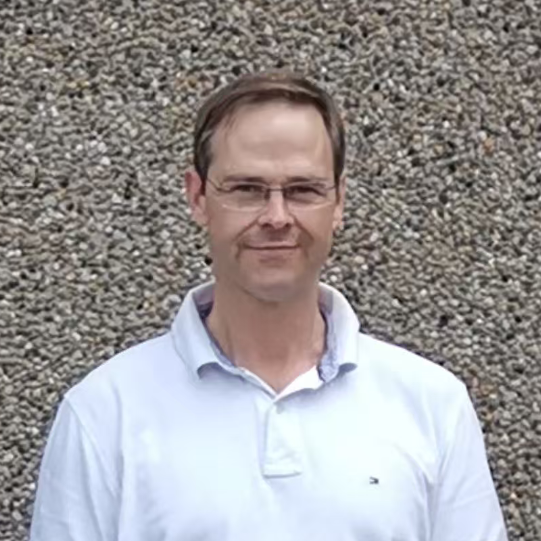
Professor Malte Grosche is a professor of condensed matter physics at the Cavendish laboratory of the University of Cambridge, as well as being a fellow and Director of studies at Trinity College in Cambridge. After obtaining his undergraduate and PhD degrees at Cambridge, he went on to be a Trinity College Title A fellow from 1994 to 1997, and then was a postdoctor at the Max-Planck-Institute for Chemical Physics of Solids in Dresden until 2001. Following this he spent 6 years at Royal Holloway as a lecturer and a reader, before coming back to Cambridge and rejoining the Cavendish in 2007.
Professor Grosche's group is based in the Quantum Matter group at the Cavendish laboratory, and focuses on investigating correlated states in quantum materials. He has made a series of important research findings, particularly in the areas of (i) the discovery and characterization of novel types of unconventional superconductors, (ii) probing physical properties of quantum materials under extreme conditions of low temperatures, high magnetic fields and high pressure using a range of experimental probes, and (iii) experimental determination of the electronic structure of correlated materials, especially by precise measurements of quantum oscillations.